Tuesday (7/5/22) - Italo Calvino's The Traveller in the Map - Opicino de Canistris (Opicinus)
From Italo Calvino's Collection of Sand:
[His] procedure was symmetrical and opposite to that carried out
by an Italian cleric from the beginning of the fourteenth century, Opicino de
Canistris. He could not speak, his right arm was paralysed, he had lost most
of his memory, and was often in thrall to mystic visions and suffered the
anguish of being a sinner, but Opicino had one dominant obsession:
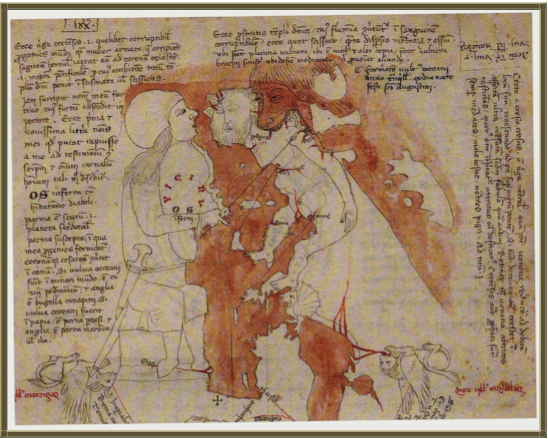
interpreting the meaning of geographical maps. He constantly drew the map
of the Mediterranean, copying the shape of the coasts all over the place,
sometimes superimposing on this drawing the outline of the same map but
orientated in a different direction, and he inserted into these geographical
outlines drawings of human figures and animals, characters from his own
life and theological allegories, sexual penetrations and angelic apparitions,
placing alongside them a dense written commentary on the story of his
misfortunes and prophecies concerning the destiny of the world.
In an extraordinary example of ‘art brut’ and cartographic madness,
Opicino simply projects his own interior world on to the map of lands and
seas. (The Traveller in the Map, 37).

Opicinus de Canistris (24 December 1296 - c. 1353), also known as the Anonymous Ticinensis, was an Italian priest, writer, mystic, and cartographer who generated a number of unusual writings and fantastic cosmological diagrams. Autobiographical in origin, they provide the majority of information about his life. When his works were rediscovered in the early twentieth century, some scholars deemed his works to be “psychotic” due to their extraordinary theological musings and schematic diagrams. Opicinus is best known for the two manuscripts he created following his illness Vaticanus 6435 and Palatinus 1993.
Vaticanus lat. 6435 - This codex looks similar to a journal written in chronological order. However, its polymorphous content, which is difficult to decipher, bears witness to the encyclopaedic culture of its author. Opicinus used all his knowledge to construct a cosmic identity appearing in numerous guises; he is God, the Sun, the Pope, Europe, Avignon, etc. Its colour anthropomorphic maps of the Mediterranean area, precise and curiously organised, illustrate "good" and "bad" characters and animals on which he projects himself and his enemies. The use of symbols, his taste for dissimulating and manipulating (words, numbers, space), and his attraction to the obscene and scatological are omnipresent and relate strongly to similar themes found broadly in medieval culture.
With 52 large colour drawings on parchment (often used on both sides) and covered with notes, Palatinus, 1993 apparently relies much less on a cartographic format ; yet, invisible maps of the Mediterranean are underlying most of the diagrams, with sometimes only a few places expressed. The drawings are extremely schematic, using human figures covered in circles and ellipses. Opicinus also included a plethora of biblical quotations, calendars, astrological charts and medical imagery.
Opicinus de Canistris World Map, 1296-1300

Cathedral of Pavia from manuscript Vatican, Pal. Lat. 1993, 1335–50

Diagram with Crucifixion, 1335–50


The “pictures” he refers to are a complex series of maps and schematic diagrams in two manuscripts currently held at the Vatican library, Palatinus 1993 and Vaticanus 6435. These drawings were a means for Opicinus to chart the spiritual realities that he believed were the underpinnings of the physical world.
Much scholarship has interpreted Opicinus’s illness as psychosomatic, specifically the product of schizophrenia. However, whatever symptomotology can be gleaned from Opicinus’s abstruse writings seems to suggest that he suffered a stroke in addition to potential psychotic episodes.
Comments
Post a Comment